How to Choose an LED Profile Diffuser for Comfortable Linear Lighting
A diffuser has a small physical size compared with the rest of a lighting installation, but it strongly affects how the finished light looks. The same LED strip can appear sharp and technical under a clear cover or soft and continuous behind an opal one. In furniture, kitchens, display shelves and architectural details, this difference determines whether the installation looks professionally integrated or simply like a visible row of LEDs.
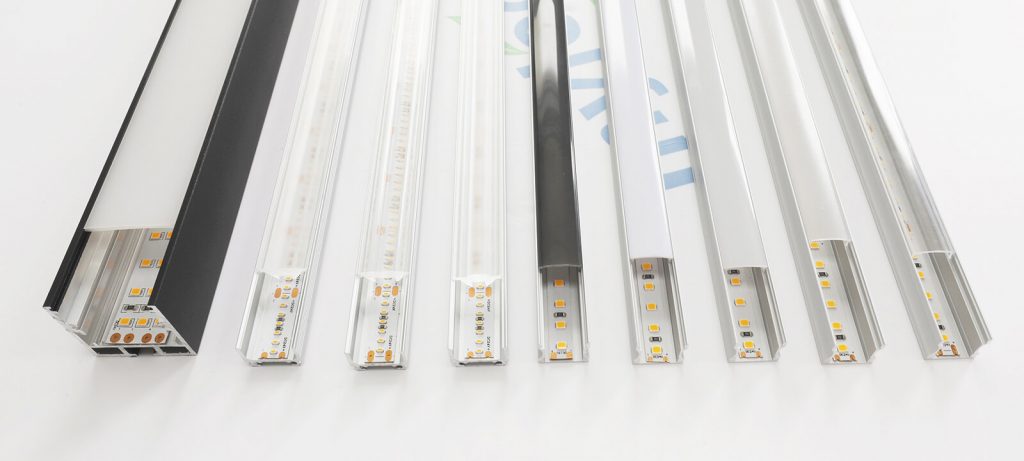
The diffuser sits above the LED strip inside an aluminum profile. It protects the strip from direct contact and changes how light leaves the channel. The amount of diffusion depends on the material, surface treatment, thickness and distance between the LEDs and the cover. Because these variables work together, choosing a diffuser is not just a matter of selecting transparent or frosted plastic.
Start with what the viewer should see
The first question is whether individual LED points are acceptable. In utility lighting, workshops or hidden technical installations, visible points may not matter. In a living room shelf, kitchen cabinet or decorative ceiling line, a dotted appearance often looks unfinished.
A frosted or opal diffuser blends neighbouring points and creates a more even luminous surface. The effect is strongest when the profile has enough depth for the beams from individual LEDs to overlap before reaching the cover. A shallow profile with a low-density strip can still show dots, even with a heavily frosted diffuser.
COB strips help create a continuous line because their emitting elements are positioned close together. With COB, the diffuser can focus more on glare control and surface appearance rather than hiding large gaps between LEDs. With conventional SMD strips, LED density and profile depth deserve closer attention.
A dedicated Diffuser should match the profile system mechanically as well as optically, so the cover clips securely into the channel and follows the intended line without gaps.
Transparent and opal covers serve different purposes
Transparent diffusers transmit light with minimal visual softening. They are useful when maximum brightness is more important than hiding the LED points. A transparent cover also protects the strip from dust and light mechanical contact while preserving a crisp beam.
Opal and frosted diffusers spread light more broadly. They reduce the contrast between bright LEDs and the darker spaces between them, which makes the line more comfortable to look at. The trade-off is lower transmitted output because part of the light is scattered or absorbed by the cover.
This does not make one type better than the other. A display case that needs strong directional light may benefit from a clearer cover. A wardrobe or bedroom shelf may look better with an opal diffuser. The correct choice follows the visual task rather than a single universal rule.
Glare is often the real problem
Visible LED points are only one source of discomfort. Glare can occur even when the line looks continuous, especially if the profile is mounted near eye level or aimed directly toward the user. The diffuser helps by spreading the light over a larger apparent surface.
Positioning is equally important. Under a kitchen cabinet, a profile mounted slightly behind the front edge can illuminate the worktop while keeping the brightest part of the source outside the normal viewing angle. On a shelf, recessing the profile by a few millimetres can reduce direct visibility. In a staircase, the light should define the step without shining into the eyes of someone walking upward.
A diffuser cannot correct a poorly positioned profile by itself. The best results come from combining optical diffusion with thoughtful placement.
The profile depth changes diffusion
A common mistake is to judge diffuser performance without considering the profile. The distance from the LED strip to the cover determines how much the light spreads before it exits. Deeper profiles generally provide better mixing, while very shallow channels emphasize the individual emitters.
The width of the profile also changes the visual surface. A narrow profile creates a thin line with higher apparent brightness. A wider diffuser spreads the same light across a larger area and can look softer. For decorative applications, that difference can be more important than a small change in electrical power.
Testing one metre of the planned strip, profile and diffuser is often worthwhile. It allows the designer to check uniformity, brightness and glare in the actual room before installing a long run.
Colour temperature still matters behind a diffuser
A diffuser changes distribution, but it does not turn warm white into neutral white or correct inconsistent LED colour. The selected colour temperature remains visible through the cover. Warm white around 2700-3000 K supports bedrooms and relaxed living spaces, while neutral white around 4000 K is common in kitchens and work areas.
The diffuser can slightly affect the perceived tone because the material scatters light, but the LED strip remains the primary source of colour. For projects where several linear lights appear in the same room, using strips from the same colour-temperature range helps keep the result consistent.
Colour rendering is also important. In kitchens, wardrobes and retail displays, good colour rendering helps surfaces and objects look natural. The diffuser should complement the strip rather than being expected to correct a poor-quality light source.
Fit and retention affect long-term appearance
The cover must match the channel. If the diffuser is too loose, it can bow or fall out. If it is too tight, installation becomes difficult and the cover can be damaged during fitting. Long profiles are especially sensitive because small dimensional differences accumulate over the full length.
End conditions deserve attention too. A diffuser cut too short leaves visible gaps near the end caps. A diffuser cut too long can buckle when the profile warms. Clean, square cuts improve the final appearance and reduce stress on the material.
During installation, the cover should be pressed into the profile evenly rather than forced from one point. On long sections, working progressively along the channel helps avoid twisting. Protective film, if present, is best removed after cutting and fitting so the visible surface stays clean.
Maintenance should be considered before installation
Diffusers collect dust like other exposed interior surfaces. In kitchens, they can also accumulate grease. A profile mounted in an accessible position is easier to clean, while a recessed architectural line may be harder to reach.
A removable diffuser gives access to the LED strip for service. This is one reason the cover should not be permanently glued into a system designed for clipping. If a strip or connection needs replacement later, the diffuser can be removed, the work completed and the cover reinstalled.
Think of the diffuser as an optical component
The diffuser is more than a protective lid. It controls visibility of LED points, influences glare, changes the apparent width of the light line and contributes to the finished appearance of the profile. Its effect depends on the LED density, channel depth and mounting position.
When choosing components for a complete linear-lighting installation, LEDUA offers profiles, diffusers, strips and related accessories that can be combined around the same design goal.
A good diffuser does not call attention to itself. It simply turns a technical LED strip into a cleaner, more comfortable line of light. That small change is often what makes linear lighting look integrated into the furniture or architecture rather than attached afterward.